
Oct. 12, 2026
Registration period: September 14 – October 12 2026
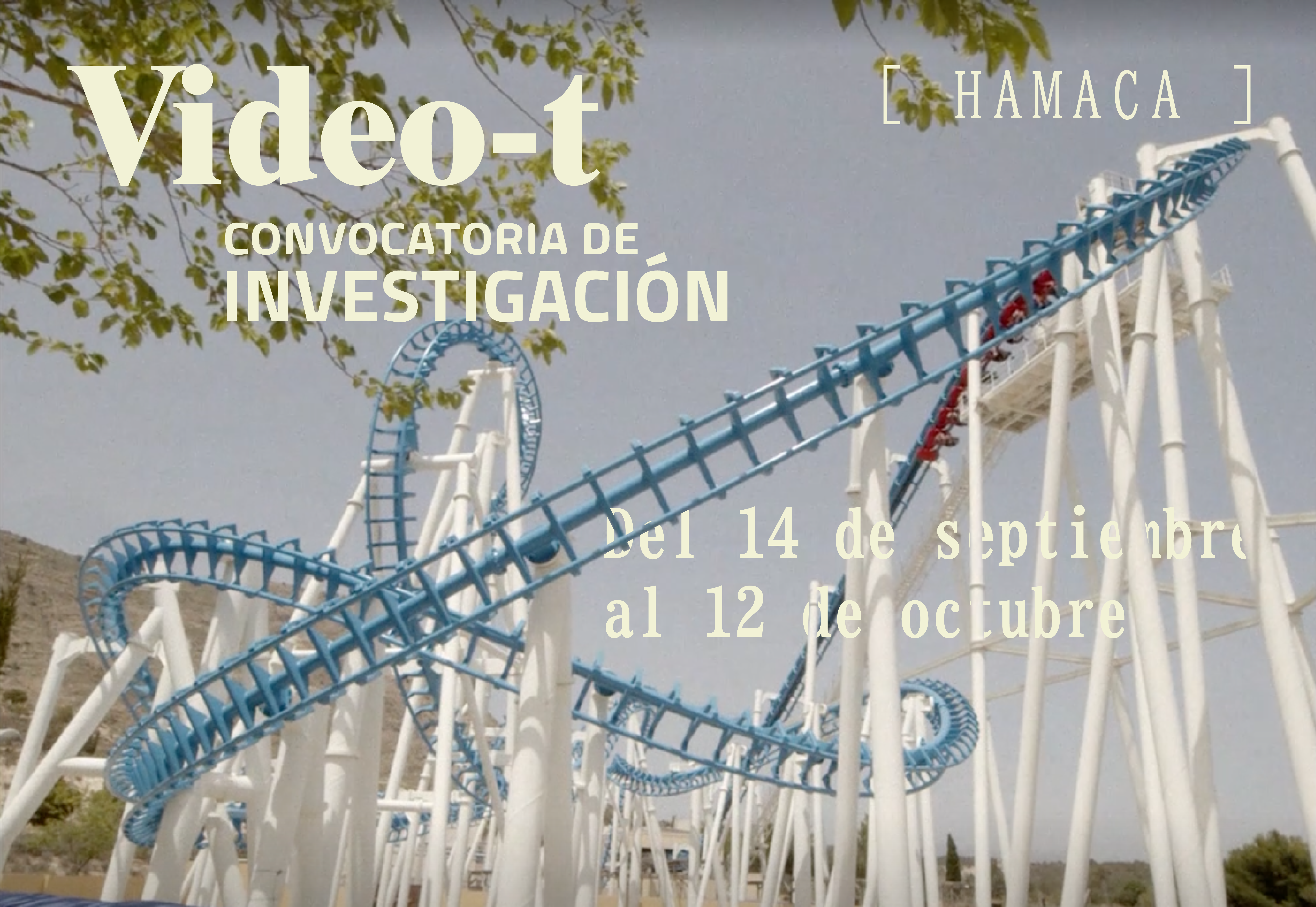
The experimental audiovisual platform HAMACA is launching the fourth Video-t call for proposals, aimed at research into the image and experimental video, with no restrictions on the type of proposals.
The call aims to fund 1 experimental research and writing project that addresses from a critical and/or theoretical perspective, processes within the field in which HAMACA operates. The project, which should be reflective and proactive in nature, must explore the present and future of experimental audiovisual art through criticism, speculation, case studies, technology, or historiography. The research must result in a written text. Participation is open to professionals in the sector (filmmakers, academics and theorists, curators and programmers, students, technicians, among others), whether individuals or collectives who are active in Spain, have a larger-scale project underway, or are interested in exploring new lines of research. Projects must be original. Priority will be given to ideas that contribute to the discourse on experimental video in order to strengthen the theory and dissemination of the medium.
The project selected in this call for proposals will receive a grant of 1500 euros. This amount is subject to the withholding tax stipulated by current legislation, which will be deducted from the grant and paid by HAMACA once the acceptance agreement has been formalized via invoice.
At the end of the research process—to be carried out over a period of 1 to 4 months following the publication of the selection, the author will submit a text (and images, if appropriate), which may be more essayistic or more experimental in nature, that documents and conveys the knowledge obtained or organized during the research.This text, the rights to which will belong to its author, will be published in digital format on Hamaca’s website and communication channels as an issue of Hamaca Publicaciones. To this end, Hamaca will hire a designer to oversee the graphic design of the project for its publication.
Registration and selection
For this edition, the project selection will be handled by Hamaca’s technical team.
The deadline for submitting applications is October 12 at 23:59h. Registration is free. The jury’s decision will be announced on November 5 at www.hamacaonline.net, and those selected will be notified by email.
Proposals must be submitted exclusively through the call for proposals form by filling out the fields on the online form and attaching the required documents. Only one proposal per applicant or group of applicants will be accepted.
Required information: Basic information about the applicant | Research CV (PDF, max. 1 page) | Project title | Research proposal and proposed methodology (between 400 and 1,000 words) | Timed work plan | Links to up to 3 previously published research texts (not necessarily academic)
Requirements
Evaluation criteria
Important: the research project must be aimed at developing a piece of experimental research and writing, not an audiovisual work. The research may be part of a larger-scale process that results in an audiovisual production, but the audiovisual work itself will not be evaluated as the central focus of the submitted proposal.
Participation in this call for proposals implies acceptance of its terms and conditions and the jury’s decision.
The grant funds will be provided in full as a single payment.The selected researcher(s) must issue an invoice to Hamaca by December 15, 2026.
Contact email: info[at]hamacaonline.net
→ Click here to see the results of the 1st Video-t Call: Estudios raros, by Núria Gómez Gabriel
→ Click here to see the results of the 2nd Video-t Call: De la guerra (notas al pie para el momento presente), by Marla Jacarilla
The call for entries image features a frame from the piece Heaven is a closed nightclub by Koba Gómez.
With the support of:

